China Top 10 Mobile Car Battery Charger Manufacturers
Choosing a dependable Mobile Car Battery Charger requires more than comparing prices, charging speed, or packaging claims. Drivers need equipment that works beside a cold roadside, inside a crowded garage, or during an unexpected morning failure. China has become a major manufacturing center for these products, offering compact jump starters, lithium chargers, smart maintainers, and professional workshop units.
This guide examines the China Top 10 Mobile Car Battery Charger Manufacturers through practical and technical criteria. These include charging stability, battery compatibility, safety protection, casing quality, certification readiness, after-sales service, and production experience. A useful principle comes from Dr. Isidor Buchmann, founder of Cadex Electronics and a respected battery educator: “A battery is like a human being. It needs good nutrition, exercise and rest.”
That idea matters.
A charger is not simply a box that pushes current into a battery. Poor voltage control may shorten battery life, while weak clamps can create heat and unreliable connections. The best manufacturers combine circuit design with real vehicle testing. Some products appear impressive online but perform differently in freezing weather or dusty workshops. This is where evaluation becomes difficult.
The ranking also deserves reflection. Factory scale does not always mean better engineering. A smaller supplier may offer stronger customization, while a large manufacturer may provide more consistent quality control. Therefore, this overview does not treat advertising language as proof. It focuses on usable evidence, product details, market reputation, and realistic ownership needs. Readers can then identify which Mobile Car Battery Charger manufacturer fits personal vehicles, fleet operations, emergency kits, or professional service environments.
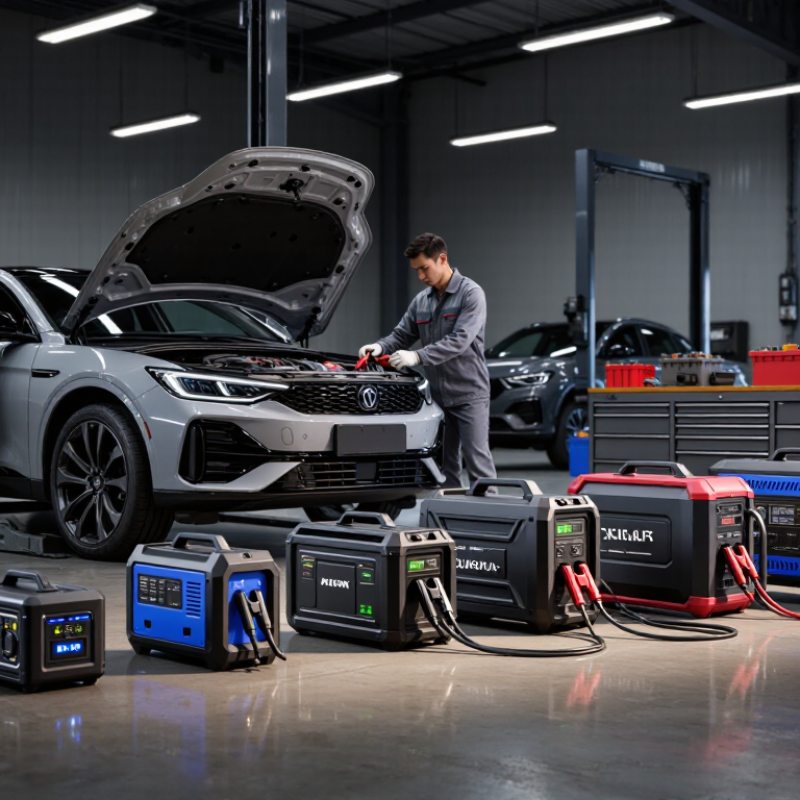
China Top 10 Mobile Car Battery Charger Manufacturers: Industry Scope and Definitions
China Top 10 Mobile Car Battery Charger Manufacturers: Industry Scope and Definitions
In this market, “mobile car battery charger” refers to portable equipment made for vehicle battery support. It may include lithium jump starters, compact AC/DC chargers, and vehicle-ready power units. The scope excludes fixed workshop chargers, household adapters, and large commercial energy storage systems. Small distinction. A jump starter supplies a short, high-current boost. A charger replenishes battery capacity over time.
For a top-ten review, a manufacturer should design, produce, or control these products in China. Assembly alone is not enough. A credible supplier should document cell sourcing, protection circuits, thermal testing, output stability, and production traceability. Useful evidence includes factory records, sample tests, warranty data, and independent certification reports. Specifications must be checked under realistic conditions, including cold starts, cable heating, and repeated discharge cycles. Many online listings emphasize peak current. That figure can mislead when duration and battery temperature are omitted.
The industry also covers OEM and ODM development, private-label production, export compliance, and after-sales support. However, these capabilities vary widely between factories. A ranking should separate manufacturing capacity from trading-company representation. Production volume matters, but it should not replace reliability data. I would also examine manuals, connector quality, testing equipment, and technical response time. Some assessments remain imperfect because testing conditions differ. That weakness deserves disclosure. Definitions should stay practical: portability, charging function, safety controls, and verified manufacturing responsibility.
How the Top 10 Manufacturers Compare by 12V/24V Output and Charging Current
China Top 10 Mobile Car Battery Charger Manufacturers
When comparing China’s top 10 mobile car battery charger manufacturers, output range matters more than appearance. Most units support 12V systems for cars, vans, and motorcycles. Some also provide 24V output for trucks, buses, and industrial vehicles. A dual-voltage charger offers broader use, but it may require clearer voltage selection and stronger internal protection.
Charging current separates practical models from basic emergency tools. Entry-level units commonly deliver 5A to 10A, suitable for overnight maintenance. Mid-range chargers often provide 15A to 30A, helping restore a weak car battery faster. Heavy-duty models may reach 40A or more for larger 24V batteries. However, maximum current is not everything. Stable current control, temperature monitoring, reverse-polarity protection, and cable quality influence real performance. A specification sheet can still hide weaknesses.
Tips: Check whether the stated current is continuous or peak. Test 12V and 24V modes separately. Inspect cable heat after thirty minutes. Smaller clamps may look convenient, but they can become warm under high current. Ask for test reports, protection details, and sample verification before ordering. One field lesson remains important: faster charging is not always safer charging. I have seen impressive numbers fail under sustained load. Manufacturers with transparent testing data usually earn more trust, even when their advertised output is less dramatic.
China Top 10 Mobile Car Battery Charger Manufacturers - How the Top 10 Manufacturers Compare by 12V/24V Output and Charging Current
| Rank |
Anonymous Manufacturer |
Primary Charger Type |
Rated Output |
Selectable Charging Current |
Typical Battery Capacity Range |
Input Supply |
Charging Control |
Safety Functions |
Typical Efficiency |
Common Enclosure Rating |
| 1 |
Manufacturer 01 |
Mobile high-current charger |
12V
24V
|
20–150A |
100–1,500Ah |
220V AC, 50Hz |
Automatic multi-stage |
Overcurrent, short-circuit, overtemperature, reverse polarity |
88–92% |
IP21–IP23 |
| 2 |
Manufacturer 02 |
Industrial wheeled charger |
12V
24V
|
15–120A |
80–1,200Ah |
220V AC, 50Hz |
Constant-current / constant-voltage |
Fuse protection, thermal shutdown, voltage limiting |
86–91% |
IP20–IP23 |
| 3 |
Manufacturer 03 |
Workshop battery charger |
12V
24V
|
10–100A |
60–1,000Ah |
220V AC, 50Hz |
Automatic three-stage |
Reverse-polarity, overload, overheat, spark protection |
85–90% |
IP20 |
| 4 |
Manufacturer 04 |
Portable service charger |
12V
24V
|
10–80A |
50–800Ah |
220V AC, 50Hz |
Automatic multi-stage |
Overvoltage, short-circuit, reverse polarity |
86–91% |
IP20–IP21 |
| 5 |
Manufacturer 05 |
Heavy-duty automotive charger |
12V
24V
|
15–100A |
70–1,000Ah |
220V AC, 50Hz |
Microprocessor-controlled |
Overcurrent, thermal, reverse connection, output protection |
87–92% |
IP21–IP23 |
| 6 |
Manufacturer 06 |
Lead-acid battery service unit |
12V
24V
|
8–60A |
40–600Ah |
220V AC, 50Hz |
Automatic CC/CV charging |
Short-circuit, overheat, overcharge, reverse polarity |
84–89% |
IP20 |
| 7 |
Manufacturer 07 |
Forklift and commercial-vehicle charger |
12V
24V
|
30–120A |
150–1,200Ah |
220V AC, 50Hz |
Programmable multi-stage |
Input surge, output short-circuit, thermal, overload |
88–93% |
IP21–IP23 |
| 8 |
Manufacturer 08 |
Compact mobile charger |
12V
24V
|
5–50A |
30–500Ah |
220V AC, 50Hz |
Automatic three-stage |
Overcharge, reverse polarity, short-circuit, fan failure |
84–89% |
IP20–IP21 |
| 9 |
Manufacturer 09 |
Battery recovery and maintenance charger |
12V
24V
|
5–40A |
20–400Ah |
220V AC, 50Hz |
Automatic maintenance mode |
Reverse-polarity, overvoltage, overtemperature |
83–88% |
IP20 |
| 10 |
Manufacturer 10 |
Entry-level workshop charger |
12V
24V
|
5–30A |
20–300Ah |
220V AC, 50Hz |
Automatic or manual selection |
Fuse, short-circuit, thermal, reverse connection |
80–86% |
IP20 |
Note: Manufacturer identities are intentionally omitted. Specifications are representative product configurations commonly published for China-made 12V/24V mobile and workshop battery chargers; exact current ranges, battery compatibility, protection functions, and enclosure ratings should be confirmed against the selected model datasheet.
Battery Charger Technologies: 6V–24V Systems, Li-Ion Support, and Efficiency
China’s leading mobile car battery charger manufacturers increasingly support 6V, 12V, and 24V systems. This range serves motorcycles, passenger cars, trucks, and workshop equipment. A reliable charger should identify voltage automatically before delivering current. That small feature helps prevent costly mistakes.
Li-ion support requires more than a simple charging port. The charger needs a suitable charging profile, temperature monitoring, and protection against overvoltage. Field testing should include cold starts, repeated charging cycles, and unstable input power. Real testing matters. Product documentation should clearly state compatible battery chemistries, output limits, and protection functions.
Efficiency also deserves close attention. High-efficiency conversion reduces heat, shortens charging time, and lowers energy waste. Engineers often examine standby consumption, cooling performance, cable losses, and charging stability at different loads. Independent laboratory reports can strengthen supplier claims, especially when comparing the top ten manufacturers. Still, specifications do not tell the whole story. Some compact units perform well on paper but become hot inside a vehicle. That weakness is easy to overlook. Buyers should inspect warranty terms, traceability, production controls, and after-sales technical support. A careful choice may take longer, but dependable charging is worth the extra review.
Applications, Production Capacity, Warranty Terms, and Export Markets of the Top 10
China’s top mobile car battery charger manufacturers serve workshops, roadside teams, fleets, and private drivers. Their products range from compact 12-volt units to heavy-duty chargers for trucks and agricultural equipment. Common applications include emergency starting, battery maintenance, fleet testing, and workshop charging. Some factories produce several thousand units monthly, while larger facilities can exceed 100,000 units annually. Capacity figures should be verified through factory audits, not brochures alone.
Warranty terms usually cover 12 to 36 months, depending on the charger category and sales contract. Reliable suppliers provide serial-number tracking, replacement parts, repair procedures, and clear exclusions for water damage or incorrect use. Export activity commonly reaches Europe, North America, Southeast Asia, the Middle East, Africa, and South America. Compliance documents, plug standards, packaging quality, and after-sales response can differ by destination. Small details matter. I have seen attractive samples fail because cables overheated during repeated workshop use.
Tips: Ask for load-test videos, production records, and a written warranty before placing an order. Confirm charging voltage, protection features, connector types, and operating temperature. Request samples from the same production line used for bulk orders. A lower price may hide weaker fans, short cables, or limited service support. Compare total ownership cost, not only the factory quotation.





 Mr. Leaf