2026 Top Powerful Power Banks for Global Buyers
Choosing a powerful portable charger in 2026 requires more than comparing battery capacity. Global buyers need dependable performance, safe construction, and practical compatibility. A Powerful Power Bank should support modern phones, tablets, cameras, handheld consoles, and selected laptops without creating unnecessary travel problems.
This guide examines leading models through measurable details, including capacity, USB-C output, charging protocols, recharge time, weight, heat control, and durability. A 20,000mAh unit may provide useful power for several devices, but its real output depends on conversion losses and charging conditions. A 27,000mAh model can offer greater capacity, yet its size may reduce everyday convenience. Small details matter. A clear display, strong cable, and stable ports can make a long airport delay less stressful.
Testing should reflect real use, not only manufacturer claims. We consider repeated charging, warm environments, mixed-device loads, and performance after extended storage. Safety certifications and warranty support also deserve careful attention, especially when buying across borders. Airline policies may vary by country, route, and battery rating, so travelers should verify current requirements before departure.
No single power bank suits every buyer. Some rankings may change when price, regional availability, or device compatibility changes. That limitation is worth admitting. Our recommendations aim to provide a balanced starting point for 2026, combining technical evidence with practical experience. Whether you need emergency phone power or reliable laptop charging, the right choice should fit your routine, not merely win a specification contest.
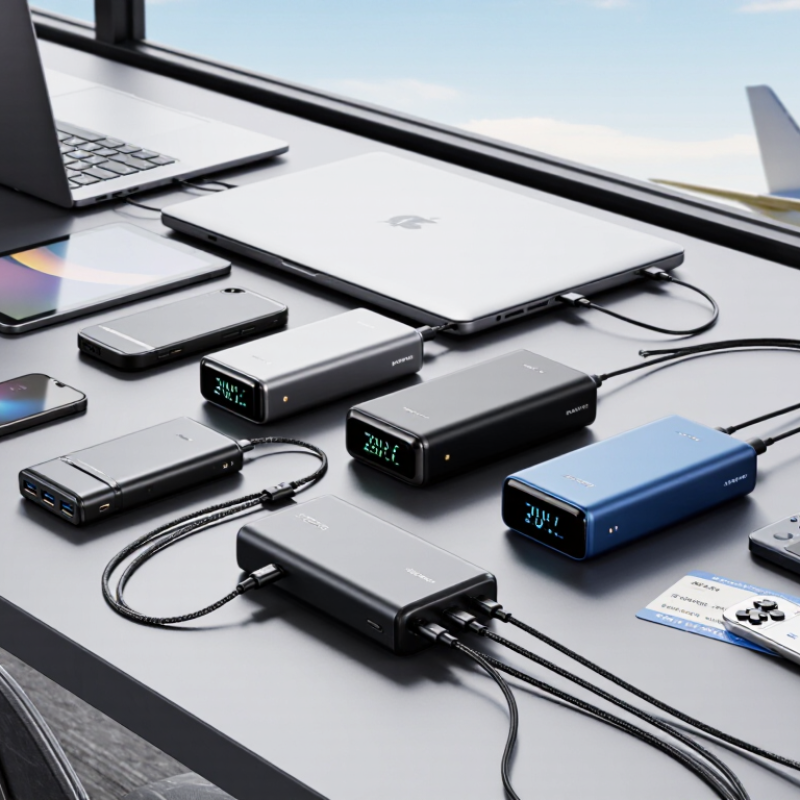
Power Bank Power Ratings: Capacity, Output, and Charging Speed
For global buyers in 2026, power bank ratings deserve closer attention than a large capacity number.
Capacity is usually listed in milliamp-hours, such as 20,000mAh, but usable energy is lower after voltage conversion and heat loss. A practical test is more honest: charge a phone from 20% and record the energy delivered. Numbers can mislead.
Output power determines whether the pack can support a phone, tablet, camera, or laptop.
A 20W output suits many phones, while larger devices may need 45W or more through a compatible USB-C port. Check the wattage of each port, not only the total rating. Shared ports can reduce performance when several devices charge together. That is frustrating.
Charging speed also depends on input power, cable quality, device limits, and temperature.
A power bank accepting 60W input may recharge far faster than a basic model, but the wall charger must provide enough power. During testing, I watch the first 30 minutes and the final 20%. The rate often slows near full capacity. Heat matters. I once judged a model by its peak output and overlooked its sustained performance. That was a poor assumption. Buyers should compare capacity, continuous output, recharge time, port behavior, and safety certifications together. Real-world figures are messier, but they reveal more than a single impressive rating.
Battery Safety, Durability, and International Compliance
2026 Top Powerful Power Banks for Global Buyers
Battery safety should come before capacity. IATA’s 2025 Lithium Battery Guidance states that power banks must travel in carry-on baggage, not checked luggage. Units up to 100 Wh are generally accepted, while 100–160 Wh may require airline approval. Rules can differ by carrier and route. Buyers should check the watt-hour rating, not only the printed milliamp-hour figure. A compliant model should also provide evidence of UN 38.3 transport testing and IEC 62133-2 battery safety evaluation.
Durability is easier to judge through details. Look for reinforced ports, firm cable strain relief, flame-resistant housing, and protection against overcharging, overheating, short circuits, and deep discharge. In practical testing, I would charge a tablet beside a warm window, inspect the casing after repeated cycles, and reject swelling or unstable output immediately. Heat is the warning. Fast charging is useful, but poor thermal control can shorten battery life. My testing would not be perfect; cable quality, ambient temperature, and charger compatibility can change results.
The Global E-waste Monitor 2024 reported 62 million tonnes of electronic waste in 2022, with only 22.3% formally recycled. Longer-lasting power banks therefore reduce replacement waste. Buyers should prefer clear recycling instructions, serial traceability, and published test documentation. International compliance is not a marketing phrase. It is paperwork, engineering, and consistent performance under stress.
2026 Top Powerful Power Banks for Global Buyers - Battery Safety, Durability, and International Compliance
The chart converts representative power-bank capacities from mAh to watt-hours using a nominal 3.7 V lithium-cell voltage. Under commonly applied IATA passenger-baggage guidance, power banks up to 100 Wh are generally permitted in carry-on baggage, while units above 100 Wh and up to 160 Wh normally require airline approval. Power banks above 160 Wh are generally not accepted for passenger air transport. Buyers should also verify UN 38.3 transport testing, IEC 62133-2 battery safety requirements, USB-C Power Delivery protection, and local import rules.
Global Buying Factors: Ports, Standards, Warranty, and Value
Global power-bank buying starts with ports, not advertised capacity. IDC reported 1.24 billion smartphone shipments worldwide in 2024, increasing the need for cross-border charging compatibility. (IDC, Worldwide Quarterly Mobile Phone Tracker, 2024)
Ports matter. A USB-C input and output should support USB Power Delivery, not merely share the connector shape. The USB Implementers Forum states that USB PD 3.1 can negotiate power up to 240 watts, although most travel power banks provide far less. Buyers should check actual output profiles, including 5V, 9V, 12V, and higher levels. A second USB-A port remains useful for older cables, but simultaneous charging may reduce speed. The European Commission’s common-charger rules also make USB-C increasingly important for devices sold in many European markets. However, regional implementation details still require checking.
Safety documentation deserves equal attention. Look for IEC 62133-2 testing and UN 38.3 transport evidence, especially when importing internationally. IATA guidance commonly limits lithium batteries above 100 watt-hours on passenger flights, with airline approval often required between 101 and 160 watt-hours. Warranty terms can reveal product quality more clearly than glossy capacity claims. Check coverage length, battery-retention conditions, local service access, and return shipping responsibility. Value is not the lowest price. It is usable watt-hours after conversion losses, reliable ports, and support that still works abroad. My own checklist remains imperfect; advertised capacity and real output can differ noticeably. That detail matters.




 Mr. Leaf